
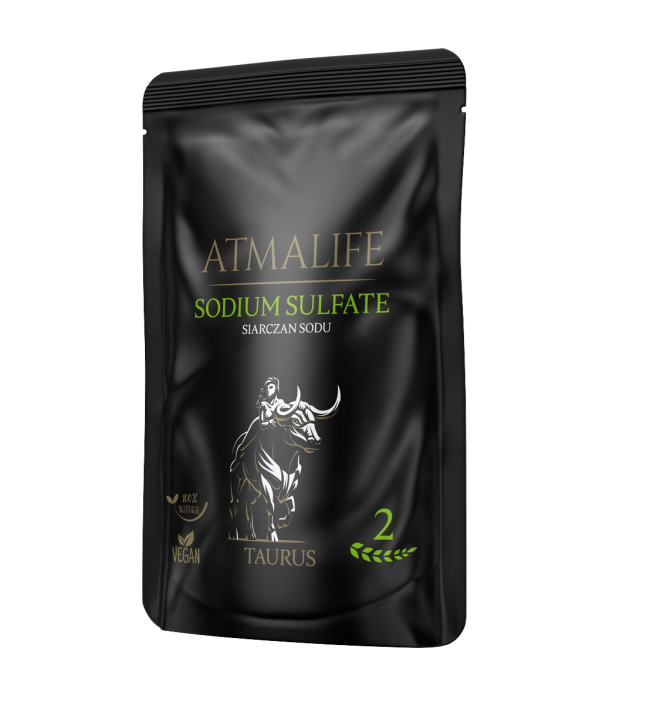
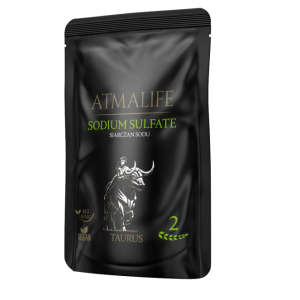
Sodium sulfate, 100 g sachet – For the sign of Taurus
This inorganic salt can be found in the intercellular fluids, and its primary role is to regulate the water levels in tissues, blood, and bodily fluids. A deficiency of this salt prevents the removal of water from tissues that is produced by the oxidation of organic substances, while sodium chloride properly distributes water throughout the tissues. Sodium sulfate ensures the quantitative regulation of water removal, eliminating excess water regardless of the cause of its accumulation.
First, the decomposition of lactic acid by sodium phosphate leaves behind water that needs to be expelled, for which sodium sulfate is essential in the required amount. Otherwise, we will face an excess of water. Second, during hot weather, water evaporates and enters the air, from where it is absorbed into the body through the lungs. Weakened individuals with digestive issues are then prone to malarial conditions because the body cannot remove the excess water due to a lack of sodium sulfate molecules to perform this task.
From a chemical perspective, one molecule of sodium sulfate has the ability to bind and remove two molecules of water. I would like to explain this in a way that everyone can understand. Biochemistry has established that chills and fever (ague), cholera, yellow fever, and other tropical diseases are caused by an excess of water in the blood and likely in the intercellular fluids. All these conditions result from the inability to assimilate sufficient sodium sulfate during digestion, which would otherwise remove the excess water entering the blood from the lungs.
Take, for example, “chills.” There is no medical authority that provides a true definition of this phenomenon. Their so-called explanations are nonsensical and consist of vague generalizations. I explain the phenomenon of chills (fever) as follows: When there is an excess of water in the blood, it is obvious that various tissues will suffer from malnutrition. This causes panic. Since there are not enough molecules to remove the water and help expel this excess naturally, nature does the next best thing—it causes contractions of the circulatory, nervous, and muscular systems, thereby forcing the expulsion of excess water—hence the profuse sweating during fever. Unless sodium sulfate is administered to maintain the balance in the body’s water management, the fever will return in about forty-eight hours, as this is the time needed for the excess water to accumulate in the blood again.
Another point: When a feverish patient climbs a mountain and reaches a high altitude, above the level where the air is very humid, and begins to breathe cooler, drier air, the fever will immediately disappear. Why? Because they receive a large dose of oxygen, which removes the excess water that was the source of the problem.
Two more things: First, excess water never accumulates in the blood as a result of drinking water, as such absorption is not possible—we only take in as much as we need. Second, solar heat does not carry decaying particles of organic matter from ponds and swamps. The water in these reservoirs, when separated from organic matter, is pure, and it is this water in the form of vapor that the sun lifts and holds in the air when it is sufficiently hot.
Thus, we learn that among the inorganic salts in the human body’s economy, **sodium sulfate**, when present in sufficient quantities, acts on water, maintains bile and pancreatic juices in their normal consistency, regulates the water level in intercellular fluids, and removes excess water from the blood. It allows for the balancing of the body’s water management and aids in stimulating the functions of the kidneys, stomach, liver, and pancreas, leading to increased detoxification of the body. The informational system of water discharge requires this salt. It facilitates the release of toxins.
No side effects are known, even if sodium sulfate is mistakenly applied, as the cells will only use what they need, rejecting unnecessary substances.
Mineral salts act from the outside, facilitating the body’s management of a given mineral (replacing what is missing with what is needed). They can improve the “vitality” of cells and penetrate the system of information transmission between cells: resolving blockages, improving the flow of information, enhancing the response to homeopathic remedies, balancing acid-base levels, detoxifying, improving the immune system, cellular metabolism, cellular structures, physical condition, and the level of sensation.
Reviews
There are no reviews yet.